


Building greening
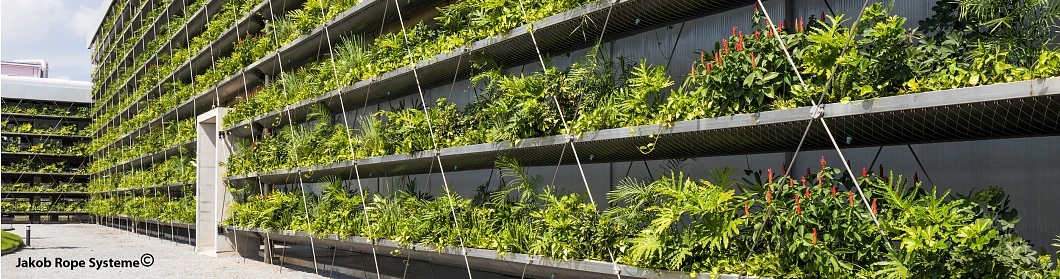

Green living surfaces and façades that combine the environment and aesthetics


Our approach
Building greening is an innovative and sustainable method of improving the urban environment by planting plants on the roofs and facades of buildings. This practice has numerous ecological, economic and social benefits. The various aspects of greening buildings are discussed in detail below.
Get in touch with us
Roof greening
Green roofs are divided into 2 categories: extensive and intensive green roofs.

Intensive roof greening
This type is similar to traditional gardens and is more elaborate. It includes a greater variety of plants such as shrubs, perennials and even small trees. The substrate layer is thicker (up to 1 m or more), which requires a stronger supporting structure of the roof. Intensive green roofs provide additional recreational space and can serve as kitchen gardens.
Get in touch with us
Extensive green roofs
This type is easier to maintain and less expensive. It uses robust, drought-tolerant plants such as sedum, herbs, mosses and grasses. The substrate layer is relatively thin (approx. 5-15 cm), which reduces the weight on the roof and makes installation easier. Extensive green roofs offer ecological added value by promoting biodiversity and improving the microclimate.
Get in touch with us
Facade greening
Façade greening is divided into 2 main systems: ground-based and wall-based systems.

Ground-based systems
With this method, plants are planted in the ground at the base of the façade and climb up the wall, either self-adhering (e.g. ivy) or with the help of metal climbing aids (e.g. climbing roses, vines, etc.).
Get in touch with us

Wall-mounted systems
Plants are attached directly to the façade in special modules or scaffolding, which are equipped with a substrate and irrigation system. These systems are often more expensive, but allow for a greater variety of plants and are independent of the soil on site.
Get in touch with us
